
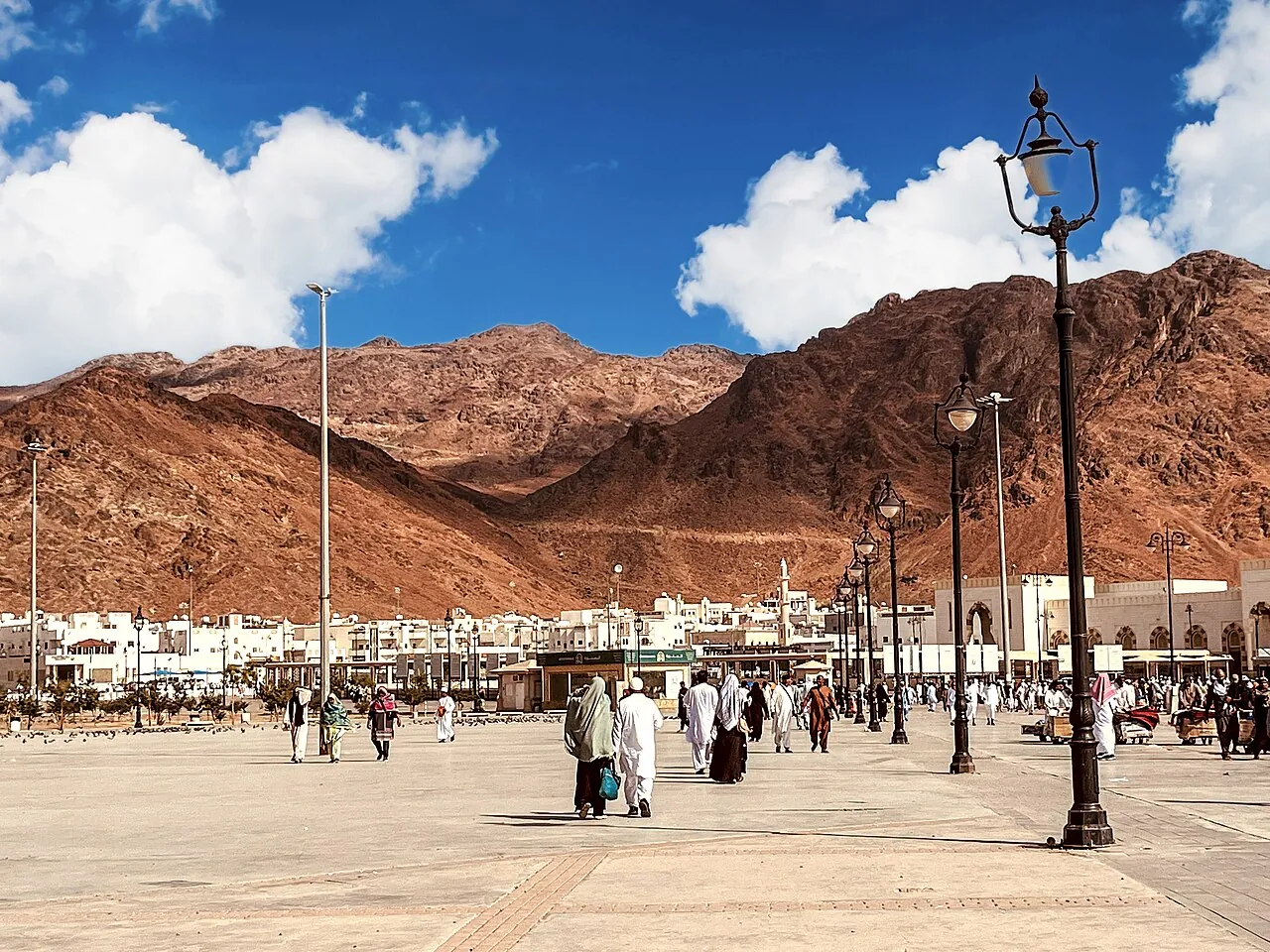
Photo: Bintladen, Wikimedia Commons, CC BY-SA 4.0
Mount Uhud
The mountain that frames the battlefield of Uhud and one of Madinah’s most recognizable natural landmarks.
Why this place matters
Uhud is inseparable from the events of 3 AH and the Battle of Uhud. The mountain and surrounding landscape help visitors understand the physical setting of one of the most consequential episodes of the Madinan Seerah.
A mountain that loves us
Returning from the expedition of Tabuk, as Madinah came into view, the Prophet ﷺ said: “This is Tabah, and this is Uhud, a mountain that loves us and is loved by us” (Sahih al-Bukhari 4422). The words make Uhud more than a landmark: it is part of the love between the Prophet ﷺ and his city.
The Battle of Uhud
The plain beneath Uhud was the setting of the Battle of Uhud in the third year after the Hijrah. The Prophet ﷺ placed fifty archers under the command of ‘Abdullah ibn Jubayr and told them not to leave their position, even if they saw the Muslims winning or losing, until he sent for them (Sahih al-Bukhari 3039).
When the enemy appeared to be in retreat, most of the archers left their post, the battle turned, and the Muslims suffered heavy losses (Sahih al-Bukhari 3039). Among the martyrs was the Prophet’s uncle Hamzah ibn ‘Abd al-Muttalib (Sahih al-Bukhari 4072). The martyrs were buried near the battlefield, two to a grave, in their blood-stained clothes (Sahih al-Bukhari 1343).
Visiting today
Visitors usually see the mountain, the cemetery of the martyrs of Uhud and the small hill of Jabal ‘Aynayn, traditionally identified as the archers’ position, in a single visit. The area lies to the north of the city.
Frequently asked questions
Why is Mount Uhud special?
The Prophet ﷺ said of it: “This is Uhud, a mountain that loves us and is loved by us” (Sahih al-Bukhari 4422), and the Battle of Uhud took place at its foot.
What happened at the Battle of Uhud?
The archers placed by the Prophet ﷺ were ordered not to leave their position (Sahih al-Bukhari 3039). Most of them left it when the enemy seemed defeated, and the Muslims suffered heavy losses, including the martyrdom of Hamzah (Sahih al-Bukhari 4072).
Visiting today
Visit respectfully and avoid unsafe climbing. The battlefield area is best understood together with Jabal Aynayn and the martyrs’ cemetery.
Sources
- Sahih al-Bukhari 4422: “This is Tabah, and this is Uhud, a mountain that loves us and is loved by us”
- Sahih al-Bukhari 3039: The Prophet ﷺ placed fifty archers under ‘Abdullah ibn Jubayr at Uhud and told them not to leave their position
- Sahih al-Bukhari 4072: Wahshi’s account of the martyrdom of Hamzah at Uhud; ‘Aynayn is a mountain near Uhud with a valley between them
- Sahih al-Bukhari 1343: The martyrs of Uhud were buried two to a grave, in their blood, without washing
- Innaha Taybah map of 50 historical and archaeological sites, Madinah Research and Studies Center: Reported by Arab News, 5 November 2024