
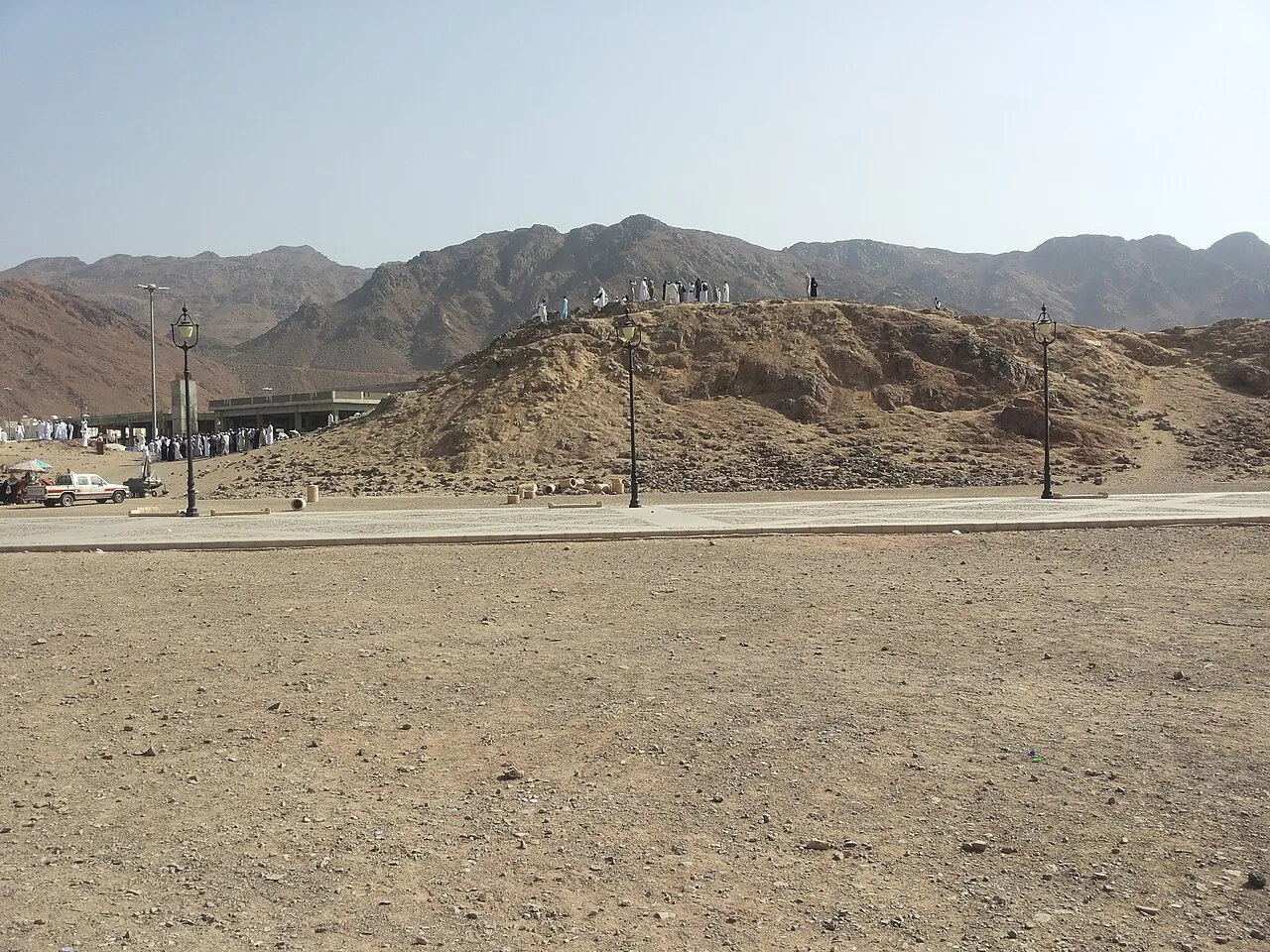
Photo: Imam Khairul Annas, Wikimedia Commons, CC BY-SA 4.0
Jabal Aynayn (Al-Rumat)
The small hill associated with the archers during the Battle of Uhud.
Why this place matters
Jabal Aynayn is widely known as Jabal al-Rumat, the Archers’ Hill. Its position makes the tactical geography of the Battle of Uhud much easier to understand.
The hill of the archers
Before the Battle of Uhud the Prophet ﷺ placed fifty archers under ‘Abdullah ibn Jubayr and told them not to leave their place until he sent for them (Sahih al-Bukhari 3039). This small hill facing Mount Uhud is traditionally identified as their position, which is why it is also called Jabal al-Rumat, “the mountain of the archers”.
Its older name, ‘Aynayn, appears in Wahshi’s account of the battle, which describes ‘Aynayn as a mountain near Uhud with a valley between them (Sahih al-Bukhari 4072).
The lesson of the archers
When the enemy seemed to be in retreat, most of the archers left the hill to join the others, and the battle turned against the Muslims (Sahih al-Bukhari 3039). The hill is remembered as a lesson in discipline and in holding to the Prophet’s ﷺ instruction.
Frequently asked questions
Why is it called Jabal al-Rumat?
Rumat means archers. The hill is traditionally identified as the position where the Prophet ﷺ placed fifty archers at the Battle of Uhud (Sahih al-Bukhari 3039).
Visiting today
The area can be busy. Respect barriers and any conservation measures in place.
Sources
- Sahih al-Bukhari 3039: The Prophet ﷺ placed fifty archers under ‘Abdullah ibn Jubayr at Uhud and told them not to leave their position
- Sahih al-Bukhari 4072: Wahshi’s account of the martyrdom of Hamzah at Uhud; ‘Aynayn is a mountain near Uhud with a valley between them
- Innaha Taybah map of 50 historical and archaeological sites, Madinah Research and Studies Center: Reported by Arab News, 5 November 2024